hankyoreh
Links to other country sites 다른 나라 사이트 링크
Experts urge emergency action as S. Korea’s medical system becomes overloaded
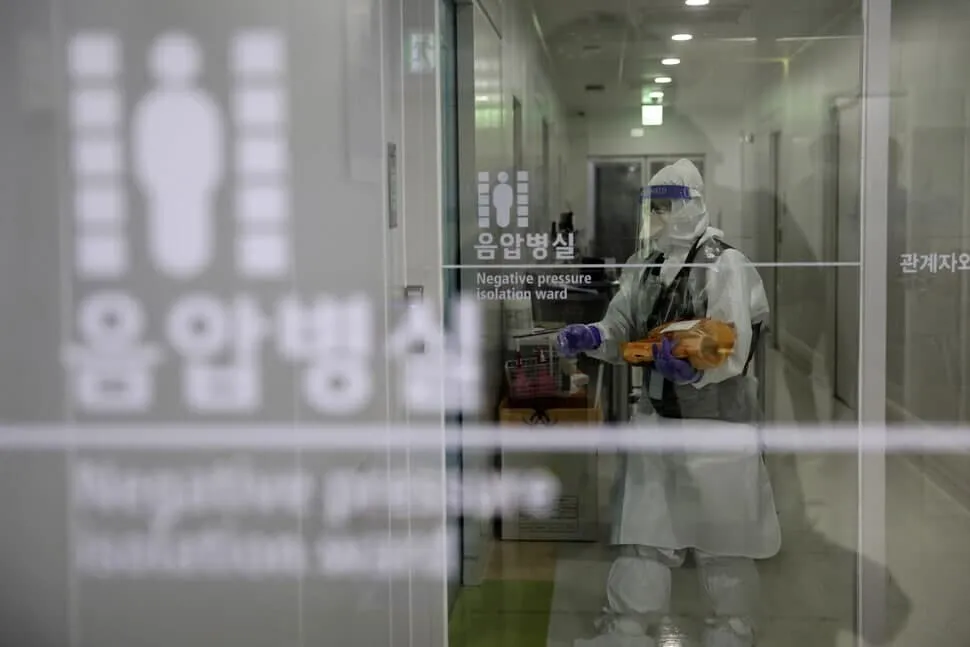
The arrival of the highly infectious Omicron variant of the COVID-19 virus in South Korea as the country’s daily caseload exceeds 5,000 is sparking concerns about whether the country’s medical system can handle the outbreak.
Despite the government’s decision to treat patients at home when possible and its efforts to acquire more hospital beds, the occupancy rate of intensive care units has soared as hospitals approach their limits. Some say that to keep medical care from collapsing the government needs to take steps to reduce the number of new cases by tightening social distancing.
ICU occupancy rate at critical pointAccording to figures provided by Korea’s Central Disease Control Headquarters, intensive care units around the country were at 78.8% of capacity as of 5 pm on Wednesday. That was 12 percentage points higher than a week ago, on Nov. 24 (66.2%).
The situation was even more severe in the greater Seoul area, where the occupancy rate was at 89.2%. ICU occupancy had also reached a critical level in neighboring cities and provinces, including Daejeon (100%), North Chungcheong Province (97.6%) and South Chungcheong Province (92.1%). That makes it harder to transfer Seoul area patients to hospitals in other parts of the country.
“Thanks to government orders and voluntary participation, we believe we’ll be able to arrange 1,300 more hospital beds, including 50 for serious cases and 190 for semi-serious cases, by mid-December. We’re doing our best to ensure that treatment of seriously ill patients isn’t disrupted by acquiring more hospital space and speeding up the hospitalization of those patients,” explained Son Young-rae, director of the Central Disaster Management Headquarters social strategy group.
While the government is devoting its energy to finding more hospital beds, the view from the front lines is that hospitals are running out of resources.
“As more people contract and die from COVID-19, hospitals are running out of room in their mortuary freezers because of the lack of capacity to cremate people who have died from the disease. The hospitals are taking a beating, but the government has done little more than talk about how serious things are,” said Jacob Lee, a professor of infectious disease at Hallym University’s Kangnam Sacred Heart Hospital.
The Korean Society of Critical Care Medicine issued a statement regarding the situation on Wednesday.
“Despite the utter shortage of hospital beds, patients are being assigned to beds without adequate consideration of the possibility of recovery, with the consequence that patients who are likely to recover aren’t getting treated. We should be considering whether patients who, on an international level, doctors agree are very unlikely to recover should be kept out of ICUs,” the society suggested.
Reducing caseload is more important than securing more hospital spaceAlong with acquiring more hospital space, experts say, the government will have to first suppress the scale of the outbreak to buy time for medical personnel and the disease control system to make the necessary changes.
That will mean toughening social distancing requirements, such as reducing the number of people who are allowed to attend private gatherings.
“As the outbreak spreads, the caseload is bound to rise as well. The situation will get even worse next week and the week after next. The government needs to take steps to decrease contact between people so as to contain the outbreak. It’s important to send signals [to the public,” said Jung Jae-hun, a professor of preventive medicine at Gachon University College of Medicine.
Korea reached a full vaccination rate of 80% on Wednesday, the level the government had said would lead to herd immunity for COVID-19. But the disease continues to spread because of repeated breakthrough infections among elderly people whose immunity has weakened. That’s due to the government disregarding calls to accelerate booster shots for people with weakened immunity when the Delta variant began to spread.
Along with accelerating booster shots, experts say, the government should take the minimum measures necessary to hold the line during the four weeks it takes for immunity to form.
“Considering that it took two to three months for the Delta variant to become prevalent in Korea, the action that’s needed is completing booster inoculation not only for the elderly but also for children, teenagers and indeed the entire public before Omicron can spread on a large scale,” Lee said.
So far, only 3.22 million Koreans, or 22% of those eligible, have received booster shots.
The government plans to decide whether to tighten disease control measures as early as this week.
By Park Jun-yong and Kwon Ji-dam, staff reporters
Please direct questions or comments to [english@hani.co.kr]

Editorial・opinion
![[Editorial] Top priority in North Korean POW case should be human rights, not politics](https://flexible.img.hani.co.kr/flexible/normal/500/300/imgdb/original/2026/0928/6117905733887763.jpg "[Editorial] Top priority in North Korean POW case should be human rights, not politics") [Editorial] Top priority in North Korean POW case should be human rights, not politics
[Editorial] Top priority in North Korean POW case should be human rights, not politics![[Column] Fixing the blurred border between South and North Korea](https://flexible.img.hani.co.kr/flexible/normal/500/300/imgdb/original/2026/0928/8617905750498627.jpg "[Column] Fixing the blurred border between South and North Korea") [Column] Fixing the blurred border between South and North Korea
[Column] Fixing the blurred border between South and North Korea- [Editorial] Shark sighting in Busan is a warning from nature
- [Column] Is AI about to destroy humanity?
- [Column] Harari’s 2030s: A new age of repressive desublimation
- [Guest essay] This Chuseok, think of the seasonal workers who plant and pick your food
- [Editorial] To build back public confidence, Lee must address issues affecting everyday Koreans
- [Column] Korea-Japan cooperation still has a long way to go
- Trump has taken a wrecking ball to America’s democratic institutions
- [Column] Sending troops to Hormuz would be a fatal miscalculation by Seoul
Most viewed articles
- 1Ukraine releases interrogation footage of captured North Korean soldiers, proposes prisoner swap
- 2Korea in talks to inject $10 billion into US nuclear reactor project this year despite still reviewing viability
- 3Seoul pushes back on Trump’s Alaska LNG claims, says investment must be commercially viable
- 4[Column] Fixing the blurred border between South and North Korea
- 5Less than half of South Koreans see need to reunify with North, survey finds
- 6Lee hails peace as ‘surest form of security’ on Korean Peninsula
- 7[Notice] Hankyoreh’s Asia Future Forum to explore ‘navigating the great upheaval’
- 8Korea’s monthly exports exceed $120 billion for first time in September
- 9Korea’s atrocities in Vietnam, in the words of those who saw and survived them
- 10Tensions mount over DMZ mine blast as North Korea alludes to military response