hankyoreh
Links to other country sites 다른 나라 사이트 링크
[Interview] “I believe in the power of books”: Moon Jae-in reflects on reading
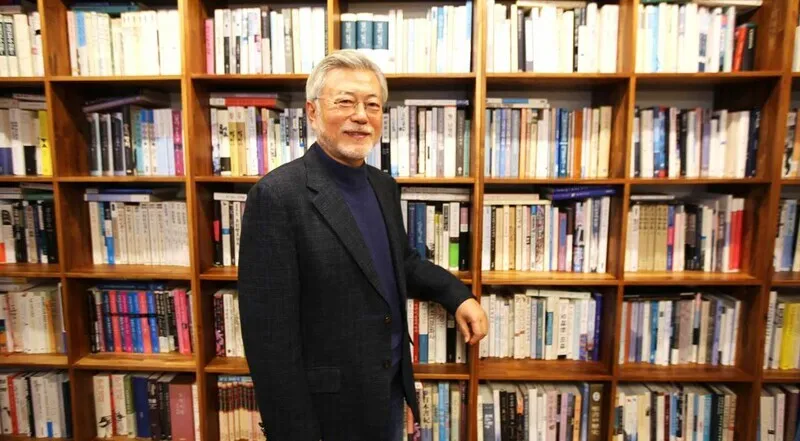
Kim Eon-ho, the CEO of publisher Hangilsa, has stayed true to his vocation of publishing over the past 47 years. At the end of last year, Kim stopped by Pyeongsan Village to meet with former South Korean President Moon Jae-in. What follows is a condensed, edited, and translated version of their three-hour interview, which focused solely on the topic of books.
After completing his five-year term as president on May 10, 2022, Moon Jae-in returned home to Pyeongsan, a village in South Gyeongsang Province. The former president is a voracious reader, so I wanted to give him some of the books we’ve published. I also wanted to take a look at his study and hear about his reading habits.
I visited Pyeongsan on a winter afternoon last year, when the countryside glowed with a ruddy light. Pyeongsan is a cozy hamlet of some 50 families on the slopes of Mt. Yeongchuk, where Tongdo Temple was established 1,400 years ago. Moon is one of a hundred or so people living there.
Moon is well-known for sharing his thoughts about several books that he read during his time in office. He has continued to recommend books even after his term ended.
One of his recommendations was “A Citizen’s History of Korea,” which was written over the course of a decade in a collaboration between more than 70 members of the Korean History Society. Moon described it as a “history book for citizens, which narrates our history objectively and excludes the statist interpretation following reflection over the debate over state-composed history textbooks.”
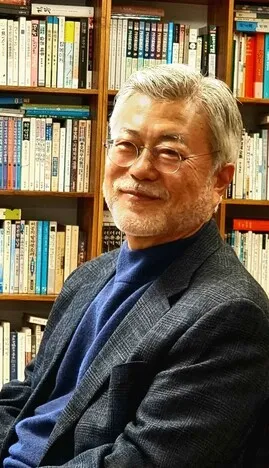
Moon Jae-in: I find the books I’m reading are a little lighter these days. But I am recommending some of the books I’ve read since leaving office. While I was president, my reading was connected to my work: I tended to read books that could come in handy in running the country. That kept me from reading novels and other guilty pleasures.
We’re the print generation, you know? I guess you could describe it as an addiction to type. To feel at ease, I always need to have a book with me. You might even say I get better sleep when I nap with a book under my head. (Laugh.)
Kim: Can you share a topic that’s been of interest to you recently?Moon: Since my term, I’ve been reading books that share insight into where our world is headed — books about how the world will be changed by the Fourth Industrial Revolution, how our lives will be shaped by COVID-19 and new infectious diseases, and about climate change, which we’re all so worried about.
Kim: Today, not only the sciences but also the humanities and social sciences and issues are undergoing a transformation in their directions and issues. What would you tell young people today who may question the significance of books?Moon: Books are an expression of curiosity — curiosity about places we’ve never been, and intellectual curiosity about the world of the unknown. I see reading as a way to satisfy that curiosity. Reading books represents the process of shaping our view of life, our worldview, and our very identity.
Kim: I suppose that readers and nonreaders would have different politics.Moon: You can see that’s true just by looking at how the Korean state and society were democratized. Without a concept of collaborators during Japan’s colonial rule, dictatorship and authoritarianism after Korea’s liberation, the division of the country that enabled that authoritarianism, and the vested interests that formed under it — in short, without a critical awareness of that reality — the democratization of our state and society would have been impossible. Indeed, readers were those who took the lead in the democratization of our society. I think that books are the strength to bring democracy into being.
Kim: I concur with that. The 1980s was the era of great books. I think the intellectual and theoretical introspection and practice that went into writing, making and reading books was the capacity to transform Korean society.Moon: That’s right. The humanities and social sciences books that were mostly published around that time gave us plenty of reading material. I think that kicked off with “Perceptions of History Before and After Korea’s Liberation.” That led to research into a new perspective on Korean history that was eventually published in book form. There were also social sciences books that were infused with a critical intellect.
Kim: I’d like to hear about what you read as a child. I understand you were in Busan for elementary, middle, and high school.Moon: My childhood was a time of widespread poverty, and not everyone who wanted to read books had access to them. The first books I read were my older sister’s textbooks. She was three years older than me, and there are a lot of interesting stories in Korean language and social studies textbooks. I would race through my own textbooks and then read hers. Since we didn’t have any books at home, that was how I enjoyed reading.
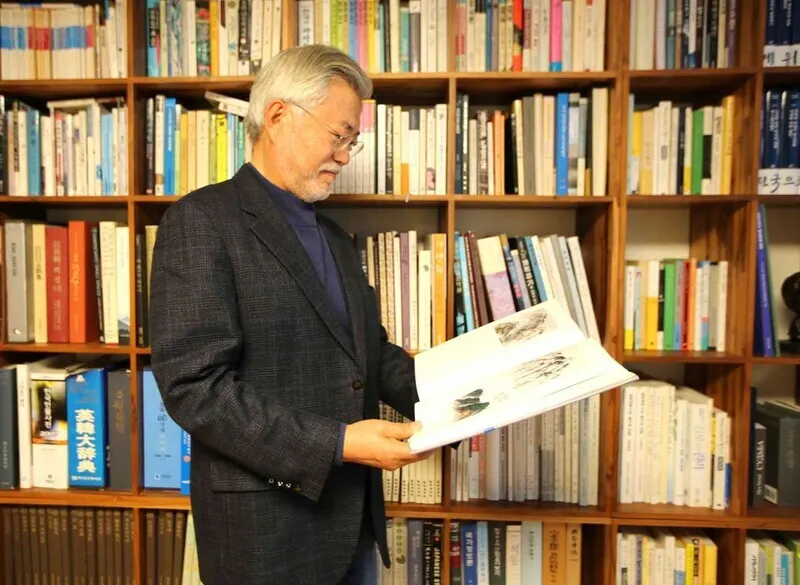
Moon: I went there too. When students enter high school, they have to buy reference books, and since the new ones were expensive, we would go to used bookstores where we could find them for cheap.
They also had a lot of used books at the stalls in the Gwangbok night market. They sold epic novels there too, at a fraction of their list price. I would buy and read epics like “Romance of the Three Kingdoms” and “Chronicles of the Eastern Zhou Kingdoms.”
Kim: When I was in high school, I read the journal “World of Thought,” underlining things as I went.Moon: I wasn’t part of the “World of Thought” generation, though I did see it at the school library.
When I entered university in 1972, I encountered the work of Rhee Young-hee. I read his book “Logic for an Era of Transition,” and it came as a real shock to my system. It’s the one book that had the single biggest impact on my life. I also read another book by Rhee Young-hee, “Idol and Reason.”
Kim: What sort of books did you read while working as a human rights attorney in Busan?Moon: I mainly read social science books. The 1980s were a time when a lot of students and other people were being arrested in connection with political events. They would be detained or arrested for owning or reading books expressing critical perspectives.
In order to defend those people, I would have to read the books in question. So I was basically reading along with these political prisoners.
Kim: It’s been beautiful to see you moving back home after finishing your term.Moon: For me, going back home was the obvious thing to do. I also came back to Busan after the end of the Roh Moo-hyun administration. A lot of the Cabinet ministers were from Busan, but almost none of them came back to Busan.
Things like regional imbalances, overcrowding in the greater Seoul region, and the decline of local communities are ultimately matters of people and money. It would be great if local talents returned home after they retired and worked on behalf of their community, but they tend to stay put in Seoul.
During the Roh administration, I was senior presidential secretary for civil affairs and chief of staff. If I’d stayed in Seoul, I could have done something like advising for a law firm that would have made me comfortable financially, but I thought it was obvious that I ought to return to Busan or South Gyeongsang Province.
Kim: During the 1980s, I did around 50 historical trips with readers and students. We would stay at places like seowon academies and Buddhist temples. In Korea’s history, those academies and temples were places of learning and training. I was surprised to hear that you were planning to open a bookshop in Pyeongsan.Moon:: Yes, I want to open up a bookshop. Even outside the Seoul area, there are publishing companies putting out meaningful books. Even in a place like Pyeongsan where I’m living now, I thought that I might open a small bookshop where I could offer various programs.
There have been bookstore movements taking place already in different regions. Bookshops have been opened in Goesan (North Chungcheong Province), Gokseong (South Jeolla Province), and the Olle Trail on Jeju Island, where they’ve been joining up with local cultural campaigns.
Kim: Is the bookshop you’re opening something that you envisioned while you were president?Moon: It isn’t something I had conceived beforehand. We’re planning to open it in a small remodeled home in the village. We’re at a stage of quietly preparing.
It started out with the idea that I might be able to do something to benefit Pyeongsan. Pyeongsan is a quiet, beautiful rural community, and when I decided to have my residence here, this quiet, beautiful village was deluged with the noise and abusive language of demonstrations, which caused tremendous psychological stress for its residents.
Seeing the problems this was causing for the people with restaurants, coffee shops, and stores here, I thought about some way of helping them, and I had the idea of a village bookshop.
I’d also like it to be a kind of salon where people in the village nearby can visit whenever they want to read, drink tea and communicate. We might be able to do small programs in connection with neighboring spaces too. It could also help with village residents’ incomes if we had a corner in it selling local agricultural products.
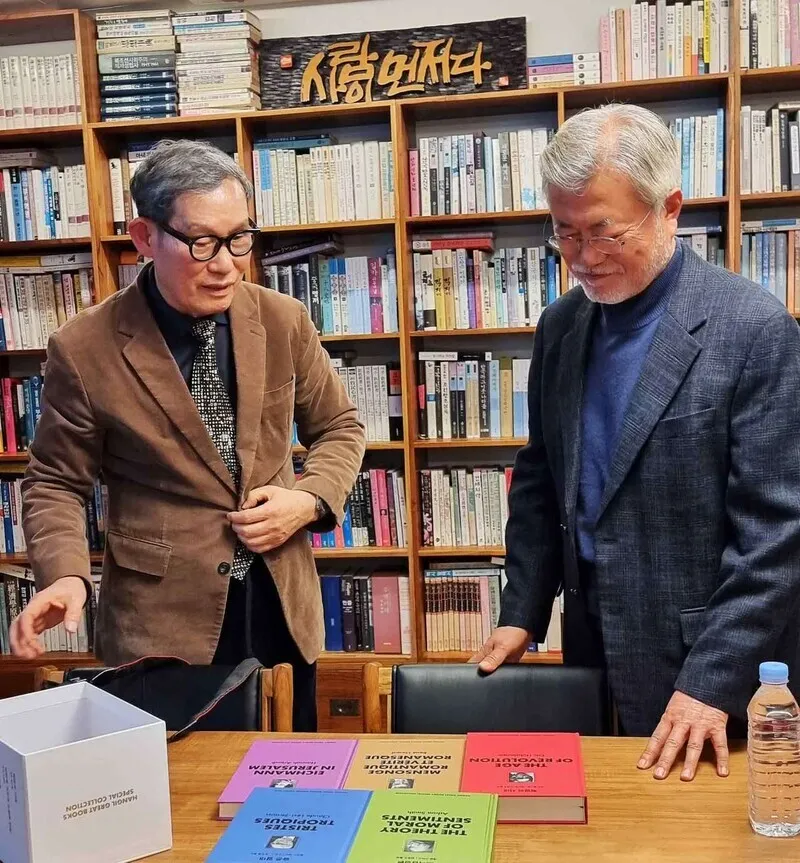
Moon: I believe in the power of books. I think books can make the world beautiful. These days, young people have been focusing so much on mobile devices and growing more distant from books, but books have a value and power that is eternal. I believe in the unique role that is held by books that are printed on paper — something mobile devices can never take the place of.
Kim: In the Chinese city of Nanjing, there’s a bookstore called Xianfeng. It’s built in an underground military bunker, and it’s become a cultural high point in Nanjing. The person who founded and runs the bookstore is named Qian Xiaohua, and in June 2018 he opened a branch of Xianfeng called Pingmin in the village of Chenjiapu in Songyang County, Zhejiang Province. Booklovers visit there from all over China. The arrival of Pingmin Books has turned Chenjiapu into a culture and art village. I can envision the bookshop you’re planning to open as that sort of thing.Moon: I’m thinking of different programs that we can offer to people in the region once the bookshop is open. We might host programs connected with student book clubs organized by schoolteachers.
We’ve also got Tongdo Temple right next door. The 17 Buddhist hermitages are beautiful too. We might be able to develop Buddhist programs in conjunction with the temple, as well as programs for studying Korean history and tradition.
The village also is home to a lot of ceramic artisans. We might work with them on pottery activities. By making use of the strong points of the region and its natural environment, I think we can go beyond the role of a bookshop to develop culture and art programs.
We could also have book reading campaigns where book clubs all over the country work together. I’d like to work with publishers, writers, and intellectuals to develop creative programs.
Kim: You could also have experts on books in different areas helping to select quality reading material. Have you decided on a name for the bookshop?Moon: I’m thinking of something along the lines of “Pyeongsan Village Bookshop.” I’d like it to be a small bookshop.
Kim: When I was writing “World Bookstore Tour,” I explored eminent bookstores around the world, and in each case, those great bookstores said they placed the biggest emphasis on their selection — the decision on which books to offer.Moon: I thought it might be nice to create the kind of bookshop that creates its own concepts, where people who support those concepts can visit and purchase books. The bookshop needs to be about more than just selling books. It needs to be a bookshop where writers and readers connect and communicate, one where readers can visit and discuss things.
Kim: If you go up Mt. Yeongchuk, you can see the beauty of the Yeongnam Alps, which connect with Pyochung Temple in Miryang (South Gyeongsang) and Unmun Temple in Cheongdo (North Gyeongsang). I can just picture readers visiting the Pyeongsan Village Bookshop and discussing books in the big silver grass fields of the Yeongnam Alps.Moon: I’m currently exploring what I can do as a bookshop proprietor to invite readers into reading. Like with publishing, I see bookshops as a program where lots of different people are working together. We might also have a program where we’re partnering with bookshops in different regions.
Kim: Opening a bookshop is an exciting endeavor, where you’re working together to realize the humanistic and artistic spirit that this era demands. When do you think it might open?
Moon: We’re planning to open sometime in February or March. Once I open the bookshop, I also want to be involved in its activities, recommending books and reading along with people. I also might post everyday images from the bookshop on my website.
The driving forces behind Moon Jae-in’s vision for a Pyeongsan village bookshop come from his love of books and the spirit of reading and the humanities. I am certain this bookshop will be a shining example for our times.
Please direct questions or comments to [english@hani.co.kr]

Editorial・opinion
![[Editorial] Top priority in North Korean POW case should be human rights, not politics](https://flexible.img.hani.co.kr/flexible/normal/500/300/imgdb/original/2026/0928/6117905733887763.jpg "[Editorial] Top priority in North Korean POW case should be human rights, not politics") [Editorial] Top priority in North Korean POW case should be human rights, not politics
[Editorial] Top priority in North Korean POW case should be human rights, not politics![[Column] Fixing the blurred border between South and North Korea](https://flexible.img.hani.co.kr/flexible/normal/500/300/imgdb/original/2026/0928/8617905750498627.jpg "[Column] Fixing the blurred border between South and North Korea") [Column] Fixing the blurred border between South and North Korea
[Column] Fixing the blurred border between South and North Korea- [Editorial] Shark sighting in Busan is a warning from nature
- [Column] Is AI about to destroy humanity?
- [Column] Harari’s 2030s: A new age of repressive desublimation
- [Guest essay] This Chuseok, think of the seasonal workers who plant and pick your food
- [Editorial] To build back public confidence, Lee must address issues affecting everyday Koreans
- [Column] Korea-Japan cooperation still has a long way to go
- Trump has taken a wrecking ball to America’s democratic institutions
- [Column] Sending troops to Hormuz would be a fatal miscalculation by Seoul
Most viewed articles
- 1Ukraine releases interrogation footage of captured North Korean soldiers, proposes prisoner swap
- 2Korea in talks to inject $10 billion into US nuclear reactor project this year despite still reviewing viability
- 3Seoul pushes back on Trump’s Alaska LNG claims, says investment must be commercially viable
- 4[Column] Fixing the blurred border between South and North Korea
- 5Less than half of South Koreans see need to reunify with North, survey finds
- 6Lee hails peace as ‘surest form of security’ on Korean Peninsula
- 7[Notice] Hankyoreh’s Asia Future Forum to explore ‘navigating the great upheaval’
- 8Korea’s monthly exports exceed $120 billion for first time in September
- 9Korea’s atrocities in Vietnam, in the words of those who saw and survived them
- 10Tensions mount over DMZ mine blast as North Korea alludes to military response