hankyoreh
Links to other country sites 다른 나라 사이트 링크
After leading charge to oust Yoon, young women and LGBTQ+ Koreans flock to unions and politics to make lasting change
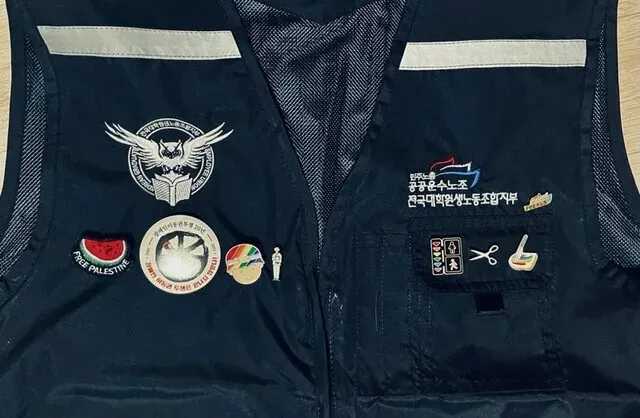
Ever since Korea was rocked by former president Yoon Suk-yeol’s botched martial law declaration on Dec. 3, 25-year-old Yu Seul-gi’s life has gone in an unexpected direction.
Yu joined the Korean Graduate Employee Union, a chapter of the Korean Public Service and Transport Workers’ Union under the Korean Confederation of Trade Unions, in early January. Now she’s preparing to set up a local union shop at the Korean Advanced Institute of Science and Technology, better known as KAIST.
While Yu has been in her combined master’s and doctoral program for five years now, she hadn’t planned on joining the union last year. But her experience as a protestor changed her mind.
Yu frequently joined demonstrations at Eunhasu Intersection, in Daejeon’s Seo District, to voice her support for Yoon’s impeachment. Those demonstrations were a vibrant forum where Koreans of all stripes swapped their viewpoints.
“I guess it was hearing all these different people’s stories that made me realize that many people who work in our society aren’t recognized as laborers. Listening to speeches by homemakers helped me see that domestic laborers aren’t generally seen as laborers. I saw joining a labor union as something I could do, right now, to ensure our society gives diverse kinds of labor the recognition they deserve,” Yu said.
Many graduate students in Korea work as researchers, but fall through the cracks of labor rights because of their status as students.
Laborers whose labor isn’t recognized
Inspired by what they learned while waving light sticks in demonstrations during the 123 days since the martial law declaration, many Koreans have been moved to participate more actively in civil society by joining labor unions and political parties. That’s especially true of the women and LGBTQ+ Koreans in their 20s and 30s who are regarded as having spearheaded the street protests.
The Korean Graduate Employee Union, which is largely composed of young people, saw its membership more than double between Dec. 2 (on the eve of martial law) and April 4. Among the new members, 51% are women and 8% are nonbinary. Because of the surge of women and nonbinary members, the total share of male union members has fallen from 59% to 41%.
Interest in politics also seems to have grown. According to the Justice Party, around 18% of people who joined the party between Dec. 4 and April 8 were women in their 20s and 30s — a notable change, since that cohort only makes up 5% of overall party membership.
NewWays, a nonprofit incubator for politicians below the age of 39, saw the number of newsletter subscribers jump from 33,959 in late November to 53,170 in early April, an increase of 56%. The number of monthly patrons also rose by 41%, from 553 to 782, the nonprofit said.
Baek Dan-bi, aged 33, became a card-carrying member of the Democratic Party a month ago. She had never attended a demonstration until the ones held to demand Yoon’s impeachment. Her political engagement has been gradually increasing — she’s on the party’s women’s committee, the youth committee and the public relations and communication committee for the Democratic Party organization in Hwaseong D District. She’s also active with Hwaseong’s youth policy deliberative body.
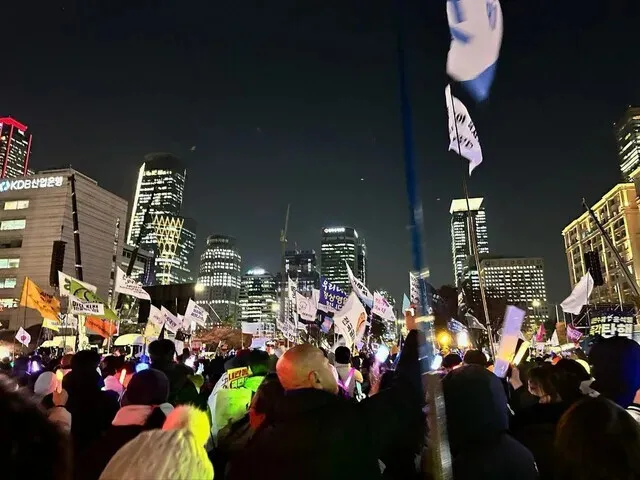
In November, Baek was forced out of her job as a video game graphic designer. While she was looking for another job, she witnessed Yoon’s declaration of martial law. Shocked by the sight of ordinary people staring down tanks, she headed to the streets herself. That was when she realized the power of democracy and civic participation.
“Middle schoolers and high schoolers made a lot of speeches at those demonstrations. I’d never thought of making remarks myself, so it was really moving to see those kids speaking in front of the crowd. As an adult, that brought a sense of guilt, and also a sense of responsibility,” she said.
Spurred to action by the sight of young demonstrators
Baek felt she needed to take more interest in politics to ensure Korea didn’t see any more attempted insurrections. With the hope of satisfying her curiosity about how politicians are selected and about how their legislative activities should be assessed from a young person’s perspective, she joined a training program for young politicians that was organized by NewWays early this year.
Once Baek was convinced that “direct participation in politics is the fastest way of bringing about social change,” joining a party was a no-brainer.
Kang Myeong-ji, a 27-year-old who goes by Mo-re — meaning “day after tomorrow” in Korean — on the social media platform X, started attending rallies in Yeouido and Gwanghwamun after the night of the martial law declaration. While she was at Namtaeryeong Pass, in Seoul’s Seocho District, to support a tractor procession affiliated with the Korean Peasants League that was trying to enter the city (Dec. 21-22), she heard about labor groups around the country fighting unfair terminations and discrimination against subcontractor employees.
Kang was soon donating to various chapters of the Korean Metal Workers’ Union, including the Geoje-Tongyeong-Goseong Shipbuilding Subcontracted Workers’ Local and the Korea Optical High Tech Co. chapter. On the final day of the year, she hopped on a bus bound for Geoje, South Gyeongsang Province, to view the first sunrise of the year. The festive event had been organized by the Geoje-Tongyeong-Goseong chapter for citizens who had supported the tractor procession at Namtaeryeong.
Kang’s fond memories of being welcomed through such gestures as gender-neutral accommodations led to her continuing support and eventual membership in a labor union.
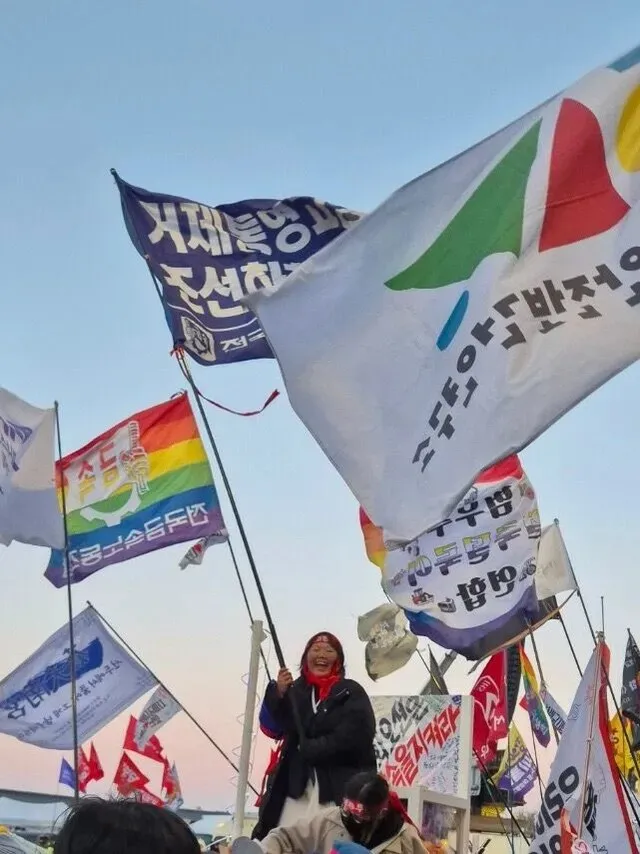
Kang is currently working on her master’s thesis after completing her coursework at Ewha Womans University. But she hadn’t even heard about the Korean Graduate Employee Union until recently.
The biggest reason she listed for joining the union was that she felt there were “always going to be limits to individual solidarity at the sites of struggle,” but that she “wanted to continue to do this kind of work.”
Her own thinking about problems around her also spurred her into organized labor.
“I’ve always thought that graduate school itself is a hard place to exist for students who can’t get any sort of economic support. I’ve thought a lot about what needs to be done to make research sustainable,” she said. Kang has been economically independent from her family since she started college at the age of 20, which has meant doing coursework while also working part time jobs.
Making research labor a viable path
So what exactly does the change these three young Koreans are seeking look like? Yu wants to use her local union shop to improve the conditions of graduate students in the country.
“Mental health is really bad among graduate students,” Yu told the Hankyoreh. “We can’t freely use our leave, and while it’s possible to take extended leaves of absence, there are also situations in which that’s not an option. Essentially, we have an environment that does not permit rest, both institutionally and culturally.”
Kang said that she hoped to encourage broader recognition of the importance of maintaining accessibility to research work in society.
“I think we’re bound to see dwindling diversity if only people who have financial backing from their families are able to go into academia,” Kang said. “I want to explore how to prevent economic issues from being a hurdle, so that people of diverse backgrounds and classes can carry out their research from their own unique points of view.”
Baek, for her part, is looking forward to the voices of young people that made the pro-impeachment rallies what they were translating into real politics.
“My view is that we need to head in the direction of embracing marginalized groups, be they migrants or LGBTQ+ people,” Baek said. “I want politicians to stop trying to drive a wedge between men and women for their own devices. As a member of the party, I want to use my voice to point out how things like that are wrong when I see them.”
By Park Hyun-jung, staff reporter; Chung In-seon, staff reporter
Please direct questions or comments to [english@hani.co.kr]

Editorial・opinion
![[Editorial] Top priority in North Korean POW case should be human rights, not politics](https://flexible.img.hani.co.kr/flexible/normal/500/300/imgdb/original/2026/0928/6117905733887763.jpg "[Editorial] Top priority in North Korean POW case should be human rights, not politics") [Editorial] Top priority in North Korean POW case should be human rights, not politics
[Editorial] Top priority in North Korean POW case should be human rights, not politics![[Column] Fixing the blurred border between South and North Korea](https://flexible.img.hani.co.kr/flexible/normal/500/300/imgdb/original/2026/0928/8617905750498627.jpg "[Column] Fixing the blurred border between South and North Korea") [Column] Fixing the blurred border between South and North Korea
[Column] Fixing the blurred border between South and North Korea- [Editorial] Shark sighting in Busan is a warning from nature
- [Column] Is AI about to destroy humanity?
- [Column] Harari’s 2030s: A new age of repressive desublimation
- [Guest essay] This Chuseok, think of the seasonal workers who plant and pick your food
- [Editorial] To build back public confidence, Lee must address issues affecting everyday Koreans
- [Column] Korea-Japan cooperation still has a long way to go
- Trump has taken a wrecking ball to America’s democratic institutions
- [Column] Sending troops to Hormuz would be a fatal miscalculation by Seoul
Most viewed articles
- 1Ukraine releases interrogation footage of captured North Korean soldiers, proposes prisoner swap
- 2Korea in talks to inject $10 billion into US nuclear reactor project this year despite still reviewing viability
- 3Seoul pushes back on Trump’s Alaska LNG claims, says investment must be commercially viable
- 4[Column] Fixing the blurred border between South and North Korea
- 5Less than half of South Koreans see need to reunify with North, survey finds
- 6Lee hails peace as ‘surest form of security’ on Korean Peninsula
- 7[Notice] Hankyoreh’s Asia Future Forum to explore ‘navigating the great upheaval’
- 8Korea’s monthly exports exceed $120 billion for first time in September
- 9Korea’s atrocities in Vietnam, in the words of those who saw and survived them
- 10Tensions mount over DMZ mine blast as North Korea alludes to military response