hankyoreh
Links to other country sites 다른 나라 사이트 링크
Meritocracy is the new aristocracy — only now it’s based on degrees, not pedigree
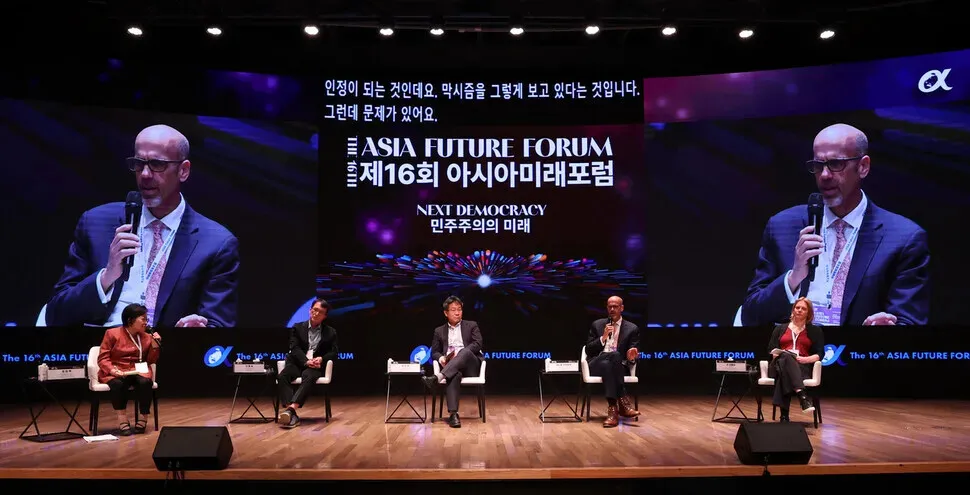
In the 2025 Asia Future Forum’s keynote session on meritocracy, speakers argued that even elites in meritocratic societies suffer from overwork and self-alienation, while those who are marginalized are humiliated for failing to meet its standards. Thus, meritocracy comes to fuel the rise of populism and a crisis of democracy.
Daniel Markovits, a professor of law at Yale Law School, delivered the first keynote address of the third afternoon session of the forum. In his talk titled “The Meritocracy Trap,” Markovits argued that meritocracy has become a social mechanism that helps elites pass on socioeconomic privileges to their children.
While meritocracy was once regarded as an innovation for distributing benefits based on achievement, today it has “created a new kind of aristocracy [. . .] based on degrees and learning rather than land and breeding.”
Markovits observed that inequality is intensifying in Korean society as well, as meritocracy drifts away from promoting equality and social mobility. As Korean elites invest massive resources in their children’s education, privileges are kept within elite society. He emphasized that the moment meritocracy loses its own moral coherence, democracy collapses from within, stressing that a major shift is needed to replace the superiority-centered thinking inherent in meritocracy with a focus on “excellence.” This is because “superiority” is based on competition, whereas excellence values accomplishing worthwhile things to a degree that is “good enough.”
Jo Littler, a professor of culture, media, and social analysis at Goldsmiths, University of London, followed with a keynote titled “The Manipulation of ‘Merit’: Cultural Politics and the Assault on Democracy.” She pointed out that in modern society, the myth of meritocracy functions as “a fig leaf” for plutocrats, legitimates the “shredding of [. . .] safety nets and [endorses] ballooning privatized assets and wealth.”
Littler’s idea of “neoliberal meritocracy” points to how the idea promotes “a competitive society organized around a hyper individualized ladder of social mobility,” in which “a few extreme winners” stand out amidst the widespread “discontent of those positioned as losers.”
Littler notes that this leads to scapegoating marginalized groups such as migrants and asylum seekers in the UK, so-called welfare queens in the US. Littler emphasized, “We need to deepen democracy rather than embrace authoritarianism, to tax billionaires and regulate asset management companies to create better quality of life for the majority of people.”
A roundtable discussion followed, moderated by Chung Hyun-back, professor emeritus of Sungkyunkwan University and former minister of gender equality and family. A heated debate on how meritocracy and inequality intertwine in Korean society unfolded, as academic elitism runs deep and conflicts between genders have been acute for many years.
Lee Cheol-sung, a professor of sociology at Sogang University, pointed to the shrinking number of decent jobs and the particular strain of Korean meritocracy which forces people to invest their all into college entrance and employment as the background for the spread of right-wing ideology among younger generations. Lee noted that Korean meritocracy is “a system that makes people devote their entire teens and twenties to two exams: first, to enter college, and then get hired by a conglomerate.”
“The fear that you will never reach your parents’ generation’s status no matter how hard you try is the tragedy at the heart of Korean meritocracy,” the Sogang professor added.
Lee Kang-kook, a professor of economics at Ritsumeikan University, identified the wage gap between employees of large corporations and small-to-medium enterprises as a core cause of inequality, stating that meritocracy, income inequality, and inequality of opportunities interlock to threaten democracy.
By Han Gui-young, director of the Hankyoreh Human and Digital Research Institute; Shin So-young, staff reporter
Please direct questions or comments to [english@hani.co.kr]

Asia Future Forum
Article 16Editorial・opinion
![[Editorial] PPP leader’s trip to US is a stunt without substance](https://flexible.img.hani.co.kr/flexible/normal/500/300/imgdb/original/2026/0417/4317764157621763.jpg "[Editorial] PPP leader’s trip to US is a stunt without substance") [Editorial] PPP leader’s trip to US is a stunt without substance
[Editorial] PPP leader’s trip to US is a stunt without substance![[Editorial] Remembering Sewol tragedy is how we prevent another](https://flexible.img.hani.co.kr/flexible/normal/500/300/imgdb/original/2026/0416/6617763295917051.jpg "[Editorial] Remembering Sewol tragedy is how we prevent another") [Editorial] Remembering Sewol tragedy is how we prevent another
[Editorial] Remembering Sewol tragedy is how we prevent another- [Editorial] Close communication with incoming US ambassador will be key for alliance
- [Editorial] World must stand against any and all tolls in Strait of Hormuz
- [Correspondent’s column] Trump’s real red line isn’t Iran’s nuclear program
- [Column] Who’s calling whom a rogue state?
- [Column] Xi Jinping exploits growing rift in Transatlantic alliance
- [Column] Trump’s war boomerangs on US hegemony and alliances
- [Column] Negotiating with bombs
- [Column] What the debate over Atlas and robots in factories missed
Most viewed articles
- 1Korean A-bomb victims head to UN to tell their stories and seek accountability
- 2[Interview] Key to stewardship code is sustainable value, not box-ticking, says expert
- 3South Korea positions itself for greater influence after end of Iran war
- 4Trump hints at renewed talks with Iran, but nuclear enrichment remains a sticking point
- 5World is ‘being ravaged by a handful of tyrants ’ pope says in dig at Trump
- 6Pushed into a corner, Sewol memorial fights to keep memory alive
- 7Trump hints second round of talks with Iran could take place over weekend
- 8Lee becomes first sitting president to attend Sewol memorial ceremony
- 9Sewol survivors say their mistake was making it off the ferry alive
- 10[Editorial] PPP leader’s trip to US is a stunt without substance