hankyoreh
Links to other country sites 다른 나라 사이트 링크
S. Korea reports 5 Omicron cases, mandates 10-day quarantine for all inbound travelers
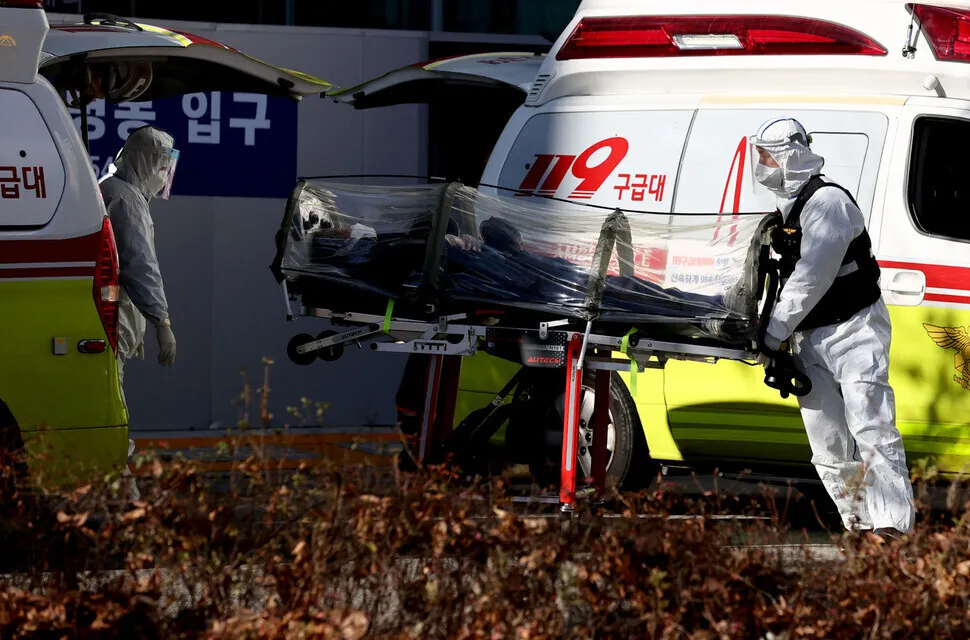
Tests confirmed on Wednesday that five people in South Korea have the Omicron variant of the COVID-19 virus, including a couple who returned from a visit to Nigeria. That news is prompting concerns that the viral variant may spread rapidly at the community level.
In an attempt to curb the spread of Omicron, the government has decided to require everyone entering Korea from overseas over the next two weeks (beginning on Friday) to self-quarantine for 10 days. Complete genome sequencing will be carried out on samples from all arrivals who test positive for COVID-19 to determine if they have contracted the new variant.
Officials at Korea’s Central Disease Control Headquarters said on Wednesday that Omicron had been detected in a married couple in their 40s and one other person who arrived in Korea from Nigeria on Nov. 24. Two other people were also found to be infected with the Omicron variant: a woman in her 50s who was diagnosed with COVID-19 after returning home from Nigeria on Nov. 23 and a friend of that woman.
The problem is that the couple in their 40s were allowed to move around freely because they were fully vaccinated for COVID-19. The delayed identification of Omicron in the two women in their 50s is also fueling concerns about community transmission of Omicron.
Given how communicable Omicron is, the Korean government convened a whole-of-government task force authorized to deal with Omicron on Wednesday. The task force devised several countermeasures that include adding Nigeria to the list of eight African countries currently facing travel restrictions. Quarantine measures on people arriving from other countries have also been tightened.
“Over the next two weeks (Dec. 3–16), people arriving in Korea from all countries other than the nine [African countries] including South Africa and Nigeria will be required to quarantine for 10 days regardless of whether or not they’ve been vaccinated,” the Korea Disease Control and Prevention Agency explained.
Both locals and foreigners on a long-term sojourn will have to undergo three PCR tests during those ten days: one before quarantine, another one day after arrival, and a third before quarantine is lifted. The government has also decided to curtail the issuance of self-quarantine waivers for people entering the country and to check for the presence of Omicron by running whole-genome or targeted gene sequencing on all overseas arrivals who test positive for COVID-19.
Korea’s disease control authorities also plan to strengthen epidemiological tracing of everyone who came into contact with people infected with the Omicron variant so as to complete the survey and registration of all contacts within 24 hours. Everyone who came into contact with Omicron carriers will have to undergo self-quarantine without exceptions for fully vaccinated individuals, and their period of self-quarantine will be extended to 14 days from the current 10.
Omicron is believed to be extremely infectious, leading the European Centre for Disease Prevention and Control to call it the most serious of any of the major viral variants that have been discovered since the COVID-19 pandemic began. Omicron was first discovered in South Africa on Nov. 11 from a sample collected on Nov. 9. It was detected in Korea just nine days after South Africa reported the variant to the World Health Organization on Nov. 24.
“This is all tentative because we don’t have much data yet, but Omicron accounts for nearly 100% of the variants that are being analyzed in South Africa. That allows us to surmise that [Omicron] spreads more rapidly than Delta and that it can reduce vaccines’ efficacy at preventing infection more than Delta does,” said Jacob Lee, a professor of infectious disease at Hallym University’s Kangnam Sacred Heart Hospital.
But some medical professionals — including Angelique Coetzee, the doctor who first alerted South Africa’s public health officials about Omicron — have raised the possibility that the variant, despite its high infectiousness, may not be that deadly.
Even though 80% of Koreans have been fully vaccinated and 22% of those eligible have received a booster shot, there are serious concerns that Omicron will lead to breakthrough infections and reinfections.
“When researching viral variants, we pay close attention to whether mutations have occurred on the spike protein. Omicron has all the previous major mutations [seen in Alpha, Beta, Delta and Gamma]. Over the course of repeated reinfections, the Omicron variant has evolved to share all the previously seen mutations,” said Kim Tae-hyung, a senior manager at biotech company Theragen Bio.
By Park Jun-yong and Kwon Ji-dam, staff reporters
Please direct questions or comments to [english@hani.co.kr]

Editorial・opinion
![[Editorial] Top priority in North Korean POW case should be human rights, not politics](https://flexible.img.hani.co.kr/flexible/normal/500/300/imgdb/original/2026/0928/6117905733887763.jpg "[Editorial] Top priority in North Korean POW case should be human rights, not politics") [Editorial] Top priority in North Korean POW case should be human rights, not politics
[Editorial] Top priority in North Korean POW case should be human rights, not politics![[Column] Fixing the blurred border between South and North Korea](https://flexible.img.hani.co.kr/flexible/normal/500/300/imgdb/original/2026/0928/8617905750498627.jpg "[Column] Fixing the blurred border between South and North Korea") [Column] Fixing the blurred border between South and North Korea
[Column] Fixing the blurred border between South and North Korea- [Editorial] Shark sighting in Busan is a warning from nature
- [Column] Is AI about to destroy humanity?
- [Column] Harari’s 2030s: A new age of repressive desublimation
- [Guest essay] This Chuseok, think of the seasonal workers who plant and pick your food
- [Editorial] To build back public confidence, Lee must address issues affecting everyday Koreans
- [Column] Korea-Japan cooperation still has a long way to go
- Trump has taken a wrecking ball to America’s democratic institutions
- [Column] Sending troops to Hormuz would be a fatal miscalculation by Seoul
Most viewed articles
- 1Ukraine releases interrogation footage of captured North Korean soldiers, proposes prisoner swap
- 2Korea in talks to inject $10 billion into US nuclear reactor project this year despite still reviewing viability
- 3Seoul pushes back on Trump’s Alaska LNG claims, says investment must be commercially viable
- 4[Column] Fixing the blurred border between South and North Korea
- 5Less than half of South Koreans see need to reunify with North, survey finds
- 6Lee hails peace as ‘surest form of security’ on Korean Peninsula
- 7[Notice] Hankyoreh’s Asia Future Forum to explore ‘navigating the great upheaval’
- 8Korea’s monthly exports exceed $120 billion for first time in September
- 9Korea’s atrocities in Vietnam, in the words of those who saw and survived them
- 10Tensions mount over DMZ mine blast as North Korea alludes to military response