hankyoreh
Links to other country sites 다른 나라 사이트 링크
[Editorial] Washington and Beijing need to stop bickering in order to resolve NK nuclear issue
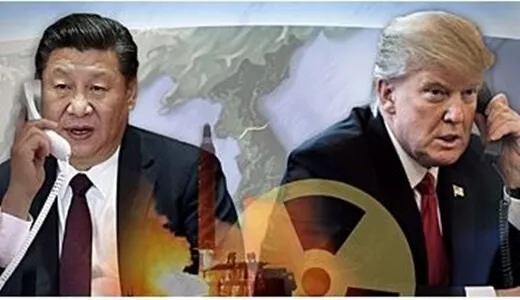
In a Sept. 3 tweet criticizing North Korea’s sixth nuclear test, US President Donald Trump wrote that South Korea “is finding, as I have told them, that their talk of appeasement with North Korea will not work.” This kind of “I told you so” response from a US President to the South Korean government the day North Korea carried out a nuclear test is embarrassing. Has there ever before been a US President like this, whose first response in a grave situation of this sort is to start blaming others?
Let’s review. First, Trump delivered a blunt threat to the North with his “fire and fury” remarks. Tensions reached their peak when the North answered with its own remarks about considering an “enveloping strike” around Guam. When things seemed to abate a bit, Trump praised Kim Jong-un as “a smart cookie.” He talked about “military options” after the North test-launched missiles, at which point his Secretaries of State and Defense had to stamp out the flames by stressing the importance of diplomacy. This has been Trump’s recent “response” to the North Korean nuclear situation. Who’s been the one stirring up confusion here?
Not only that, but just before the latest nuclear test, Trump made vague remarks about scratching the South Korea-US Free Trade Agreement, although it was impossible to tell if it was meant as a negotiating threat or an actual plan. Is this a normal way for a US President to treat the alliance in the face of the North Korean nuclear situation?
The US press has been unanimous in its criticism. Reporting on Trump’s “talk of appeasement” tweet, the New York Times quoted experts as calling his perceptions “misguided” and fearing they could prove an obstacle for cooperation between the South and US on North Korea. A Washington Post editorial said Trump’s hinted withdrawal from the KORUS FTA would be “a wildly irresponsible move, undermining relations with Seoul at the worst possible moment,” as well as “a gift to [Kim Jong-un], who dreams of splitting the bond between Seoul and Washington.”
A large part of the reason things have arrived at a sixth nuclear test by the North also stems from the way Washington and Beijing have continued marching in place, bickering and blaming each other without coming together to address the issue from a global perspective. Even now, the US is pressuring China to halt its crude oil supplies to North Korea, which China appears to have no intention of doing. An editorial in China’s Global Times stressed that Beijing should “take actions in the country’s [China’s] interest” and “reduce the risks confronted by Chinese society.” Not only do we have no way of knowing that a halt to crude oil supplies will actually lead North Korea to stop its nuclear program, but we can’t rule out the possibility it will actually make things worse. Yet the response from China shows it is focused entirely on its own self-centered considerations and strategy, worrying more about US advancement in northeast Asia than North Korea’s advancement with its nuclear capabilities.
China is no longer a peripheral nation in all of this. A final resolution to the North Korean nuclear issue will require more responsible action from the US and China, the G2 countries that are effectively dividing the world. The North Korean nuclear issue is an extremely difficult one that will never be resolved so long as Washington and Beijing continue approaching things with a narrow mindset, basing their calculations solely on their own national interests and support base.
Please direct questions or comments to [english@hani.co.kr]

Editorial・opinion
 [Column] What it will take to make a US-North Korea summit happen
 [Editorial] Seoul must be ready for anything with North Korea
- [Column] Is this America’s last Red Scare?
- [Column] Becoming stupid: Kindness videos, Blinkist and duanju
- [Editorial] USFK commander must retract, apologize for denying Korea’s territorial sovereignty
- [Editorial] US is in no position to lecture Korea about ‘fair treatment’
- [Column] The era of weaponizing intelligence to bring allies to heel
- [Correspondent’s column] US midterms: A contest of money vs. public sentiment
- [Column] Life’s too short to search for meaning in Trump’s bullshit
- [Reporter’s notebook] Why Korea can’t seem to get rid of sexual exploitation sites
Most viewed articles
- 1Blue House doubles down on Lee’s plan to review ‘special treatment’ for multicultural families
- 2Lee under fire for saying foreign workers ‘don’t do much’ for Korea’s economy
- 3[Guest essay] A general who talks too much, an ally who wants too much
- 4[Editorial] To become a leading nation, Korea must build self-reliance
- 5In a multiplex world, Korea must reduce US dependence, pursue pragmatism, says Acharya
- 6SK Hynix tops 100 tril. won in quarterly revenue, says memory shortage will last through 2030
- 7US denies visa to another senior Korean lawmaker from ruling Democratic Party
- 8[Column] What it will take to make a US-North Korea summit happen
- 94 years after losing loved ones, Itaewon families continue to fight lies and hate online
- 10Samsung’s semiconductor business breaks 100 trillion won in profit in Q3, a new record