hankyoreh
Links to other country sites 다른 나라 사이트 링크
No childbirth facilities in one in every four cities nationwide
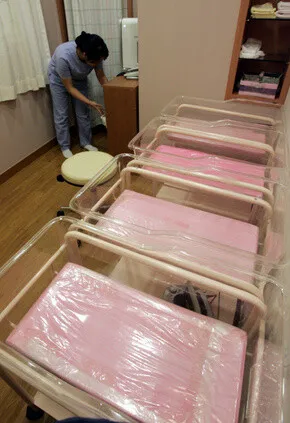
For one year, there were no childbirths at hospitals in one in every four cities or districts nationwide. According to data collected in 2007 by the Health Insurance Review and Assessment Service, 35 out of 132 local governments, excluding district governments in the Seoul metropolitan area, or 26.5 percent, reported no childbirths in 2006. None of these regions have hospitals equipped with the personnel or facilities necessary for cesarean sections or natural childbirth.
There are no maternity wards in more than a third of the cities and districts in South and North Jeolla Province and Gangwon Province. In addition, there are no such facilities in five cities or districts in South Gyeongnam Province, four in North Chungcheong Province, three in North Gyeongsang Province and two in North Chungcheong Province. In particular, there are no maternity wards in hospitals in Chilgok, North Gyeongsang Province, and Cheongwonm North Chungcheong Province, even though the annual number of newborn babies is more than 1,000 in the two districts, respectively.
Many pregnant women who reside in farming and fishing regions with no facilities for childbirth have posted comments on Internet cafes centered around childbirth describing the difficulties they have experienced due to a lack of facilities for childbirth.
Some of these regions operate “mobile delivery rooms” for pregnant women, but reports say the service is not effective.
The number of hospitals with maternity wards has declined in Seoul as well. The HIRA data shows that 522 out of 577 gynecologists in Seoul had no cases of childbirth in 2006, nine out of every 10 gynecologists. The number of gynecologists who did not deliver babies soared 25 percentage points last year. The same data showed that 382 out of 582 hospitals did not have childbirth facilities in 2005.
The situation is not likely to improve as long as the low birthrate, high number of medical malpractice cases and relatively low fees doctors can charge for delivering babies continues.
“Considering that a natural childbirth costs about 400,000 won, we could cover the investment if we had at least 20 patients delivering a baby per month,” the director of a obstetrics and gynecology clinic in Seoul said.
Baik Eun-jeong of the Korean Association of Obstetricians and Gynecologists pointed out that childbirth costs more in physical strength, time, money, potential for medical mishaps and investment burden than similar expenses incurred by any other area, urging the government to provide policy assistance rather than criticizing doctors for being selfish.
Please direct questions or comments to [englishhani@hani.co.kr]
Editorial・opinion
 [Column] What it will take to make a US-North Korea summit happen
 [Editorial] Seoul must be ready for anything with North Korea
- [Column] Is this America’s last Red Scare?
- [Column] Becoming stupid: Kindness videos, Blinkist and duanju
- [Editorial] USFK commander must retract, apologize for denying Korea’s territorial sovereignty
- [Editorial] US is in no position to lecture Korea about ‘fair treatment’
- [Column] The era of weaponizing intelligence to bring allies to heel
- [Correspondent’s column] US midterms: A contest of money vs. public sentiment
- [Column] Life’s too short to search for meaning in Trump’s bullshit
- [Reporter’s notebook] Why Korea can’t seem to get rid of sexual exploitation sites
Most viewed articles
- 1Blue House doubles down on Lee’s plan to review ‘special treatment’ for multicultural families
- 2Lee under fire for saying foreign workers ‘don’t do much’ for Korea’s economy
- 3[Guest essay] A general who talks too much, an ally who wants too much
- 4[Editorial] To become a leading nation, Korea must build self-reliance
- 5In a multiplex world, Korea must reduce US dependence, pursue pragmatism, says Acharya
- 6SK Hynix tops 100 tril. won in quarterly revenue, says memory shortage will last through 2030
- 7US denies visa to another senior Korean lawmaker from ruling Democratic Party
- 8[Column] What it will take to make a US-North Korea summit happen
- 94 years after losing loved ones, Itaewon families continue to fight lies and hate online
- 10Samsung’s semiconductor business breaks 100 trillion won in profit in Q3, a new record