hankyoreh
Links to other country sites 다른 나라 사이트 링크
[Analysis] Government-subsidized conservative groups on the attack
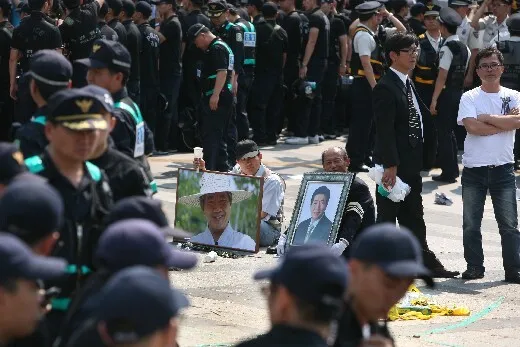
After a period of relative inactivity, conservative groups have begun responding violently to activity from other civic groups holding differing opinions. This was clearly demonstrated with Wednesday morning’s surprise destruction of the incense-burning memorial site to former President Roh Moo-hyun in front of Daehanmun at Seoul’s Duksu Palace. Critics are calling this, “An act harmful to social diversity and the coexistence of ideas.”
Until early May, conservative groups appeared to be distancing themselves from the Lee Myung-bak administration as it entered its second year in office by abstaining from active pro-administration assemblies. Conservative groups also restrained themselves from engaging in any activities against the large-scale gathering of progressive civic and social groups on May 2, the one-year anniversary of the first candlelight vigil demonstration. Indeed, some groups, including the New Right National Union, openly expressed dissatisfaction with the administration by asking, “What has President Lee done for those of us who worked hard on behalf of the presidential election?”
Since late May, however, the approach of conservative groups has changed and groups have begun holding gatherings. Some figures connected with civic and social movements are pointing to active support from the administration as playing a role in this change. The Ministry of Public Administration and Security (MOPAS) allocated lumps sum of tens of millions of Won in “subsidies” to conservative groups on May 7, while the Ministry of Environment and the Ministry of Labor have jointly discontinued their projects with progressive groups and have begun new projects with conservative groups.
The National Action Campaign for Freedom and Democracy in Korea (NAC), which dismantled the Daehanmun citizens’ memorial, received 31 million Won from MOPAS for its “campaign to protect the Constitution and foster an advanced citizen mindset.” At the same time, the Veteran Captain’s Association, of which NAC director Seo Jung-gap is a member, received 30 million Won for “research into national security strategy, seminars, education, and a campaign to carry out state administration tasks.” The Korea Freedom Federation received 190 million Won in government subsidies for two projects, including its “campaign to safeguard law and order in order to foster maturity in citizen consciousness.” These groups drew attention by reporting an assembly in Seoul Plaza during the date the “June 10 nationwide rally” was planned, a move was observed as an attempt to deny the June 10 rally based on a conflict of location.
Other observers are claiming that the police’s selective enforcement of the law is breeding violence from conservative and far right groups. In February, the police branded some 1,800 civic and social groups participating in the People’s Conference Against Mad Cow Disease as illegal and violent groups, while leaving off the Korean Disabled Veterans Association for Agent Orange Victims, which held a violent protest in front of the MBC building last July while the Association of Former Agencies for HID, members of former counter- intelligence military units, stormed the offices of the New Progressive Party, assaulting party officials and breaking fixtures. When a controversy erupted over the police’s double standard, they presented the feeble excuse that “because the two groups were punished for acts of violence rather than for violating the Assembly and Demonstration Law, they were not designated as an illegal and violent group.”
The double standard also extends to the reporting of assemblies. The police disallowed some 42 downtown assemblies by progressive groups in May and June, but they accepted the NAC’s application for a “citizen’s rally to denounce the North Korean nuclear program and former President Kim Dae-jung,” in the plaza in front of Seoul Station on Wednesday afternoon. When the police received further flak about their double standard, an official with police intelligence responded, “You could say that the front of Seoul Station isn’t downtown.”
Bong Tae-hong, the head of Right Korea, says, “The recent activity by conservative groups merely reflects the people’s concerns about national security, which have grown because of things like the North Korean nuclear issue, turning the month of June into a month about national defense.” Bong added, “The violence coming from some groups is unfortunate, but even that was likely done out of a conviction and with a willingness to accept the repercussions.”
An Jin-geol, the economy department head for the People’s Solidarity for Participatory Democracy society says, “The police must apply the same standards to the conservative and right wing groups that go around brutalizing citizens and visiting broadcasters to issue threats they applied to progressive groups, and the subsidy money allotted to them should be taken back.”
Please direct questions or comments to [englishhani@hani.co.kr]
Editorial・opinion
 [Column] What it will take to make a US-North Korea summit happen
 [Editorial] Seoul must be ready for anything with North Korea
- [Column] Is this America’s last Red Scare?
- [Column] Becoming stupid: Kindness videos, Blinkist and duanju
- [Editorial] USFK commander must retract, apologize for denying Korea’s territorial sovereignty
- [Editorial] US is in no position to lecture Korea about ‘fair treatment’
- [Column] The era of weaponizing intelligence to bring allies to heel
- [Correspondent’s column] US midterms: A contest of money vs. public sentiment
- [Column] Life’s too short to search for meaning in Trump’s bullshit
- [Reporter’s notebook] Why Korea can’t seem to get rid of sexual exploitation sites
Most viewed articles
- 1Blue House doubles down on Lee’s plan to review ‘special treatment’ for multicultural families
- 2Lee under fire for saying foreign workers ‘don’t do much’ for Korea’s economy
- 3[Guest essay] A general who talks too much, an ally who wants too much
- 4[Editorial] To become a leading nation, Korea must build self-reliance
- 5In a multiplex world, Korea must reduce US dependence, pursue pragmatism, says Acharya
- 6SK Hynix tops 100 tril. won in quarterly revenue, says memory shortage will last through 2030
- 7US denies visa to another senior Korean lawmaker from ruling Democratic Party
- 8[Column] What it will take to make a US-North Korea summit happen
- 94 years after losing loved ones, Itaewon families continue to fight lies and hate online
- 10Samsung’s semiconductor business breaks 100 trillion won in profit in Q3, a new record